The LA Times blog is reporting that AMPAS has reversed its decision to disqualify The Dark Knight's original music score for the 2009 Oscars.
The music, for me, was one of the most compelling bits of The Dark Knight, but I think--at this point--I can safely say that I HATE The Dark Knight, and every time I see it mentioned in print, I want to bludgeon the writer. Also, The Dark Knight, The Dark Knight, The Dark Knight.
Showing posts with label Movies. Show all posts
Showing posts with label Movies. Show all posts
08 December, 2008
Introducing: 'Ben vs. The Dark Knight,' The Blog Category


22 September, 2008
'Burn After Reading' - Review

But, then again, I'm no Coen bros. expert (I probably saw The Big Lebowski when I was about 14, and I don't remember a single second of it [Sacrilege!]), and I get haircuts with the singular intent of keeping my hair short enough to not have to brush it, so I don't know where that leaves us...
At the least, I think we can agree that Burn After Reading isn't as good as No Country For Old Men, and nor did it want to be. It is silly, and wacky, and goofy, and doesn't carry the heavy burden of much intelligence or genuine empathy, at least not in the deep and existential way No Country did. Burn After Reading is decidedly superficial.
John Malkovich plays an ex-CIA man, fired from the job for alcoholism, and so bitter and so soured from--what? ...existing?--that he apparently hates everyone and everything, and therefore thinks that what he really ought to do is write his memoirs. George Clooney is married to a children's book author and works for the government as a federal agent and seems consigned to occupational impotence (and is, conversely, a closet pervert). Frances McDormand and Brad Pitt are the dimwitted boobs from the local Hard Bodies gym, who unintentionally inflict their hopeless pipedreams (i.e., a head-to-toe makeover) onto everyone else, when they find a CD of numbers and names and "secret shit" and try and sell it to the Russians. Tilda Swinton is an ice-cold bitch (inexplicably at the center of a jealous love triangle), Richard Jenkins is the boss of the boobs at the gym, and J.K. Simmons and David Rasche are two CIA agents who are left trying the make sense of what eventually becomes a very messy situation.
And, you know, I really think that's all there is to it. These characters, each a little goofier than the next, spend the hour-and-a-half runtime casually circling around each other, variously crossing paths and stepping on each other's toes and proving that, I guess, everyone who ever wanted something out of life is an idiot. Or something like that. I think.
Everyone in this movie is so over-the-top, and yet still so unequivocally simple. They make stupid decisions and talk with funny intonations and, time after time, fail to understand--or even remotely "get"--what's going on around them. The big joke at the end of the movie is that the CIA, who is in the business of Intelligence, really just can't find any. At least not here, in America, where people are mean-spirited and paranoid and horny and angry and just-plain dumb.
And don't get me wrong, dumb people can be funny. And Burn After Reading can definitely be funny. Really funny, in fact. You know, it's actually a pretty good joke, having the CIA chase after a bunch of goofs, who really have no plans, no idea what they're doing, and really don't warrant such scrutiny. This is the Coen's unique brand of intelligent observation (...of morons).
But then there are these awkward moments, sprinkled throughout the movie, where things feel like they (gasp!) get a little too serious. I mean, I guess that's the Coen's schtick, right? Finding--and exploiting--those tricky moments where comedy and violence intersect? But whereas, say, while Fargo's climactic woodchipper scene is all-at-once shocking and morbid and darkly witty--succeeding because the madness has stemmed out of a questionably "sane" world (a world grown, inevitably, unwieldy and out-of-control by Unpredictability)--the whole universe of 'Burn After Reading' already seems a little too nuts.
So when McDormand freaks out when partner-in-crime Pitt fails to return from a secret mission, her immediate emotive response feels so genuine that it actually feels...false. And when Clooney, who spends 80% of his screentime mugging at the camera, employing pratfalls, and generally cultivating the bizarrest personality for a sex-hound ever, suddenly wells up with so much real emotion that he calls his absent wife and really truly wants her to come home and comfort him...well, it doesn't seem right. Not in this movie, anyway. It makes for a really discombobulating experience, where it isn't quite as easy as it should be to laugh at each character's outrageous tics and madcap personalities. At least not when we're supposed to believe they were shedding genuine tears (or sharing remotely honest desires) in the previous scene.
And they go around and around in circles like this. Much like the story itself. Every bit of new information is based on a non-fact or a misinterpretation, and once the pieces of the plot are set in motion, it doesn't really ever cover new ground. It just circles back on itself, letting one character serendipitously run into another, or revealing a hidden relationship between two already established characters. It meanders between their misguided lives, without motive or purpose, save for watching them screw things up even more. When McDormand and Pitt meet "the Russians," the endeavor doesn't get them anywhere, or open up any new options for the story--it's a joke, in-and-of-itself, to simply meet "the Russians." The Cold War is over, but they don't "get" it. Ha ha.
And then it circles back, and the CIA agents don't get why these boobs would meet the Russians, and ex-CIA Malkovich doesn't see what the Russians have to do with anything. Exactly.
Watch the trailer here.
Heard The New Bond Theme?
No? Well here it is:
I like it. I think it's...good. Really pretty good. But not great. Not "Goldfinger" great, and certainly not "GoldenEye" great. But really pretty good. Of course it means nothing without the accompaniment of Bond titles. They add so much.
Thanks to stereogum.
For better audio, check out the official stream.
Also, on a completely unrelated note, did I ever tell you how much I love ELO's "Evil Woman"? No? Well here it is:
23 August, 2008
'The Dark Knight' Is No Longer The Best Movie Ever
04 August, 2008
'The X-Files: I Want To Believe' - Review
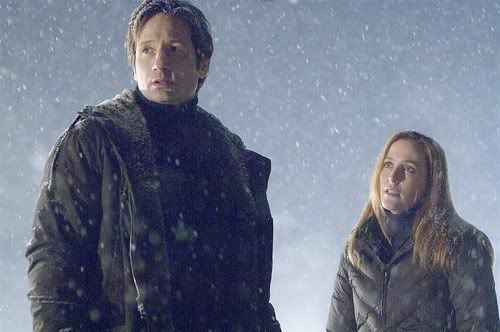
The fundamental theme at the heart of The X-Files (both the series and this new movie) is the search for truth, and it’s relationship to faith. As always, both Mulder and Scully have their own personal faiths, as well as their doubts. Scully, who is now working as a doctor in a Catholic hospital, is treating a boy whose illness requires painful and extremely experimental treatments for any chance of survival. The way this compelling subplot weaves into the main story of the priest and the missing agent is mostly based on overlapping themes, but it also expertly fleshes out Scully’s complex response to the case, and her feeling towards Mulder’s involvement in it.
'The Dark Knight' - Review And/Or Diatribe
It was okay.
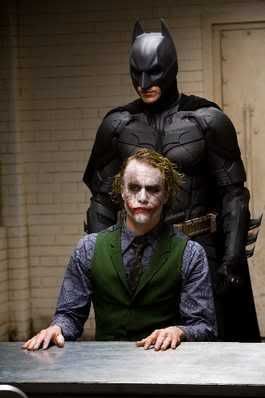
And that’s fine, I guess. You could argue that that makes him a good villain, and I would, of course, understand your point. He’s mesmerizing, in a way. In his speech in the hospital, to the newly two-faced Harvey, the Joker talks about hating “schemers” and their “plans.” He says, “If I tell the press that tomorrow … a truckload of soldiers will get blown up, nobody panics”—because deaths like these have become part of the status quo. There is an allure to what he says, because it sounds tragic and unjust. His argument is tantalizing, and what he says quickly starts sounding like…truth. And, neatly, this line of reasoning by the Joker—who is tarted up in a candy striper’s uniform (okay, acquiring that costume must’ve required some sort of forethought and planning, right, Mr. J?)—inflames Harvey so much that he concludes that the system is at fault for it’s own corruption. His own corruption. That the ‘system’ allowed the Joker to kill Rachel. The ‘system,’ as represented by Batman, and Lt. Gordon, and Harvey himself. Interestingly, this message is echoed by another character later in the movie: “You crossed the line first, sir. You squeezed them, you hammered them to the point of desperation. And in their desperation they turned to a man they didn’t fully understand,” argues Alfred to a disenfranchised Batman. Somehow, it seems, the Joker has convinced us that he is the hero of Gotham City, and maybe of The Dark Knight—or, at the very least, that he is a necessary, and perhaps even innate, evil.
The problem is, I don't know if I believe what that last sentence implies (that there can be no order without chaos, or that you have to break the rules to succeed). I could go on and on about my complicated response to Heath Ledger's Joker, and, accordingly, The Dark Knight itself (because, after all, isn't so much of The Dark Knight's success linked to the Joker?). But just understand this: in a twisted, ironic way, I like the movie less because it's so damn popular. I don't want to sound snobbish or out-of-touch, but why are people so damned passionate about such a demented, terrible, perverted killer? What does it mean when 6-year-old kids are playfully asking if their friends want to know how they got these scars?, or that you can "Become a Fan of" The Joker on Facebook? Why is this movie, and particularly this character, striking such a nerve, especially with young people? The more I think about it, the more frustrated I get. Are we all just closeted nihilists and anarchists? What does it mean if we are? so I'll stop.
Sigh. I don’t know. If I stop all this analyzing (or, you might easily argue, over-analyzing), then I’m afraid I’ll feel the opposite effect from what you’d expect: I’d like The Dark Knight less. It’s made with master craftsmanship, and it looks and sounds fantastic. When all the gears are aligned, it hums along with a satisfying briskness and ingenuity. But, it’s just…well, I like my big budget movies to be a little bit more than mindless, populist crowd-pleasers, packed with as many explosions, gadgets, and one-liners as the focus groups found appropriate. I like it when my movies think. So I understand that the Joker, as a character, was carefully constructed by Chris Nolan, his co-writers, and especially Heath Ledger, to arouse certain responses, and that it was an intentional choice to keep his origins elusive and his underlying motivations murky. I just don’t think I responded all that favorably to their creation. Maybe I just don’t like chaos.
But at least I can take a little comfort in one thought: With The Dark Knight grossing in excess of $400 million, following one of the most carefully planned marketing schemes in Hollywood history—for a Warner Bros. release that was meant to be the studio's (a subsidiary of Time Warner Inc., by the way) biggest summer tentpole release, no less—it's refreshingly ironic to think that as we passively participate in the status quo in such a ‘meta’ way, the Joker would be sitting back and laughing at us all?
30 July, 2008
New Trailer! - 'Harry Potter and the Half-Blood Prince'

All I can say is: YESSSSSSSSS!
The pensieve flashback, with Dumbledore visiting a young (and definitely creepy) Tom Riddle at the orphanage, is exciting stuff. And seeing Ron and Ginny in various states of, what appears to be, immediate and life-threatening danger is chillingly good. It would have been nice to see some Snape or even some Draco, but for a brief teaser, it's almost better this way.
Siskel and Ebert and Roeper and Others and the Movies
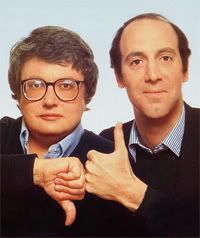
In that article, Roger posted a couple YouTube videos of some promo outtakes with himself and Gene Siskel. These guys are pretty awesome.
28 May, 2008
‘Indiana Jones and the Kingdom of the Crystal Skull’ – Review
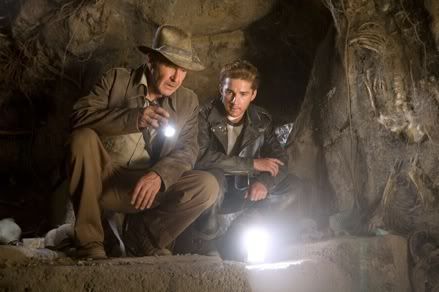
But now that that’s out of the way (and I think we’re in agreement so far), I really have to admit a couple points to myself: 1), National Treasure and The Mummy—and, indeed, Crystal Skull—have such an unabashed joyfulness in reckless adventure that I find myself admiring their offhandedness, and 2), The visual wit of Raiders (and, to a lesser extent, Temple of Doom and Last Crusade) is still here—it’s just buried under layer after layer of self-referential citation.
Too often, movie sequels inspire an obligatory “checklist” in their audience (and, for that matter, their filmmakers)—and I think the more beloved the original, the truer this axiom. Fedora? Bullwhip? Underground tomb? It’s all here, and then some. You’ll find, among other thematic repeat offenders, secrets hidden in plain view (sometimes right under your feet!), issues of trust and duplicity (i.e., “So what are you, some kind of... triple agent?”), and righteousness in the face of greed (“Their treasure wasn't gold, it was knowledge.”). But this is a dangerous game for filmmakers, as no two viewer’s expectations are ever the same. Favor conservatism, and the film is labeled a retread. Sway too far into novelty and fans complain about the changes. It’s the proverbial double-edged sword (though you could argue that the best solution would have been to simply not make another Indiana Jones movie…but that’s a moot point. Where there’s money to be made…).
So, of course, Steven Spielberg, George Lucas, and screenwriter David Koepp made incredible miscalculations in the plot. Gone is the user-friendly Christian mythology that was so successful for Raiders of the Lost Ark and Last Crusade. Instead, we’re treated to a convoluted story about Soviet communism, parapsychology, mind-control, Aztecs, aliens, and expected (but tiresome) questions of parentage. And, unfortunately, that’s it—it doesn’t add up to anything. Plot points are hit, pert jokes each have their turn, and one regurgitated sequence after another only serves to remind you of another time in the series when Spielberg and Lucas and Harrison Ford pulled it off better. And because each of these moments comes packaged with its own pre-made punchline, based solely on recognition, the purpose of the 'jokes' is to “get” the 'jokes' (i.e., that Indy is old, that ants are the new snakes, etc.). Sometimes this works—like when Indy shifts gears into problem-solving mode (watching Ford as Indiana Jones is a kick, as he reinhabits the ticks and mannerisms of his most iconic character)—but usually it doesn’t (see: “ants are the new snakes”).
But that assessment's not totally fair, and I say that for two reasons. One, because even when the gears aren’t quite lining up and you can feel the effort behind the hamhandedness, there’s still some genuine pleasure to be gained from the attempt. Cate Blanchett makes as unconvincing a Soviet spy as I’ve ever seen, but the slipping accent and cartoon-dominatrix persona seem to be what makes the role fun (for her and, maybe, us). And when Blanchett asks Indy to find a single artifact in an eerily familiar military warehouse, stocked with wooden government crates—well, of course Indy hasn’t been there before and won’t know his way around, but…hasn’t he? It’s like the characters know as much about themselves as we (the audience) do, and because we’ve already seen such an enormous storage center (in Raiders), what’s the point in pretending we haven’t? Simply, places like that don’t exist in reality, but we believed it 17 years ago, so the characters themselves are willing to unquestionably believe in such a space.
And two, while the story is lacking, it’s the deft visual eye of Steven Spielberg that elevates Crystal Skull, if not to Ark/Temple/Crusade levels, than at least to the positive side of The Phantom Menace. Notice how even the most rote sequence can have moments of brilliance. For example, Crystal Skull begins on a highway in the
So where does that leave me? Indiana Jones and the Crystal Skull is, at times, a discombobulated mess. But certainly a tentpole picture like this is almost exclusively about spectacle, and as a serial adventure it doesn’t have to follow all the established rules of logic, or even come close to them, right? Therefore, maybe Crystal Skull has more in common with the “Indiana Jones” spirit than I (and it’s detractors) would like to believe—not because it rehashes all the past successes of the series, but because it harks back to the pulp serials of Steven Spielberg and George Lucas’ childhoods (which inspired the character in the first place). Where else would you find man-eating ants and an adventurer swinging through the vines of a rainforest? Isn’t it kind of refreshing to have a movie as enamored with logic and history as The Da Vinci Code, but function without the deadening weight of it’s own bloated self-importance (which, perhaps, explains the venture in plot from the spiritual to the supernatural)?
Inevitably, though, Crystal Skull doesn’t quite work. It’s like drawing in a coloring book. Though you may have all the “perfect” colors from your crayon box, sometimes you’re just stuck with the wrong picture for what you’ve got. Sure, the sun isn’t supposed to be purple, but damn if it’s not a pleasant shade of purple, and kind of endearing in it’s kindergarten simplicity.
08 May, 2008
What I Love: Delayed Movie Titles
Movie titles can be an art, in and of themselves. In March, Nerve compiled an admirable list of The Twelve Greatest Opening Credits in Movie History, which included some of my personal favorites, like Do the Right Thing and Dr. Strangelove. Of course, the list cited the work of the two biggest names in title design--Saul Bass, who did some of his best work with Scorsese and Hitchcock (e.g., Vertigo), and Kyle Cooper, who's best known for his collaborations with David Fincher . (Stanley Kubrick must, along with these other directors, be placed in the upper echelon of design collaborators, for his work on Strangelove, The Shining, 2001: A Space Odyssey, etc.)
Sometimes opening credits are great because of impeccable graphic design (like in Catch Me If You Can), or sometimes because they set the perfect tone for the movie that follows (Monty Python and the the Holy Grail). Sometimes the credits are entirely better than what follows (Cooper's Dawn of the Dead [2004]).
There has been a recent mini-trend, however, which I absolutely love, and must acknowledge...
You expect a movie to have titles. You expect to see them, after the start of the movie, within a reasonable length of time. But sometimes a movie will play with that expectation, and make you wait. And wait. Until at some point, you've forgotten you're waiting, and you're simply watching a movie. The story has begun, there's no turning back. And then, BAM-- Credits.
I've got two examples--Michel Gondry's Eternal Sunshine of the Spotless Mind and Martin Scorsese's The Departed (above). Both movies wait until the end of the first reel of film (about 20 minutes in) to get to the opening titles. And in both cases, watching them for the first time, it was at the titles when I realized I was watching a masterpiece. It's such a maverick decision to pull the audience out of the action of the (already developing) story, and remind us we're watching a movie--but it also displays the incredible control these directors have over their medium. In a time where it feels like, in Hollywood, everything's been done before, to withhold the credits and delay our systematic pleasure in the routines of even fine cinema--well, it seems audacious.
So, one thing I LOVE... is delayed movie titles.
(Oh, and great end credits, too. But not lousy ones. Like, alas, 2004's Dawn of the Dead remake. You don't get a link for that. Because it's end credits suck.)
30 April, 2008
'Forgetting Sarah Marshall' - Mini Review

(View the trailer for Forgetting Sarah Marshall here.)
You Shall Pass!

24 April, 2008
At Long Last, 'The Hobbit' Has a Director (Officially)

I, for one, don't like the idea (and that's not just because I've had a long-standing [but fleeting] hope that Peter Jackson and New Line would come to their senses and put the Tolkien-maestro himself behind the camera). I simply think Guillermo's and J.R.R.'s styles are too dichotomous. While they both are drawn to fantastic--but ultimately human--characters, Del Toro's visuals are a bit too metaphoric for my taste, his characters a bit too allegorical. The Hobbit needs to function as a parable, for sure, but above all Tolkien writes about characters. Characters that need the assured hand of a born humanist like Jackson.
I admit that Del Toro's Hobbit may very well be visually stunning (though, perhaps, a bit too dark or dank), because Del Toro certainly has a capable imagination. But to think of the decisiveness and unbridled spirit Jackson could have brought--or the intelligence and reverie someone like Alfonso Cuarón would provide--I feel a bit too disappointed to revel in the thought of a future that holds not one but two new films from Middle Earth.
11 February, 2008
The Best Thing About The End of the Writers' Strike

Scarlett Johansson: A Case of Diminishing Returns

So shouldn't I be more excited about the news that Scar Jo and Penelope Cruz have a steamy love scene in Woody Allen's new movie, Vicky Cristina Barcelona?
I've come to realize that the more I see Scar Jo, the less I like her. Back when she was fresh and new to the Hollywood scene, her scintillating mix of vulnerability and understated sex appeal, showcased in intelligent turns in top-notch indies like Ghost World and Lost in Translation, made her into the thinking man's dream babe. There was a mystery about her, as if she knew more about life (and, perhaps, sex) than she'd ever let on except under the most intimate of circumstances. But the more popular she got, the more confidence she displayed (see photo above), and the less interesting she became. Gone is the sense of mystery and measured vulnerability, to be replaced with a blatant and self-congratulatory awareness of her own sex appeal. Which actually makes her less sexy. Sigh.
(Apparently, the two actresses, Johansson and Cruz, also have an on-screen threesome with Javier Bardem. Now he's mysterious.)
10 February, 2008
Amy Winehouse + 'Quantum of Solace' = Awesome

And anyway, if not her, than who? Who would be your top choice to sing Quantum of Solace's theme?
Subscribe to:
Posts (Atom)


 Posts
Posts